Tuesday, September 22, 2015

¡Qué Bonitos Colores! / What Pretty Colors!

   One of my favorite things to do at the beginning of every year, is a fun Color unit. And this year, I get to focus on teaching the colors, color words and help children create color word sentences in Spanish!
   Each day, Monday through Thursday, I take a small group of 10-11 children into my Spanish classroom. We start our morning with greeting each other in Spanish, then proceed with some calendar activities and some songs. We learn a new skill, read a story and then work on a large group activity. Once the large group activity is done, the children are free to have some individual work time, in which they can choose which materials in the classroom they would like to work with. I plan to change out materials weekly to align with the topic/theme that we are learning about. We close our Spanish class with a review of what we learned and a short story read in Spanish.
   Last week, after working on how to greet each other in Spanish, we began learning about primary colors!
   (I created these small color posters and they will be available for you soon!)
One good book that I love to use as an introduction to colors (in either language) is "Brown Bear Brown Bear" /"Oso Pardo, Oso Pardo."  It is a fun book that the children are all familiar with, and I like to read it and give them a chance to hear it in Spanish!
   My children are grouped accordingly for Spanish class. The Kindergarten age children are all in one group and the 3 & 4 year olds are all in a different group, and so forth, as a primary Montessori classroom consists of children between the ages of 3-5 years old.
   Most of the children fall within the 4 year old range and have had little to no formal experience in Spanish. They are currently learning Spanish color words so they did this version of my Brown Bear activity:
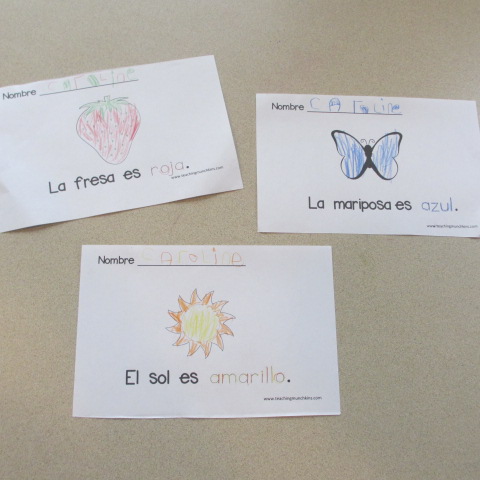
  My Kindergarten age group have already had some experience and practice in learning some basic spanish, as many of those children have been at the school for a year or two. So when I work with that group, I kick it up a notch. They are currently learning how to use Spanish words that they already know, within a context and are working on speaking in simple Spanish phrases and sentences.
  Here is the version of the activity that the Kindergarten age group worked on:
   We have also been focusing on the three primary colors: Red, Yellow, Blue. 
   My 3 & 4 year old groups have been working on learning and saying the color words in Spanish. I used these cute Color Easel coloring sheets from Open Wide the World.
  The children in my K group have been practicing how to use the color words in simple sentences. And after creating color word sentences and reading them in Spanish, they go on to complete their own coloring sheet to take home. 
     So, I want my spanish classroom to reflect what is learned in the primary classroom, in regards to how children conduct themselves and how the choose and work with different materials.  In the primary classroom, there is alot of time devoted to "work", so every day at the end of class there is usually about 10-15 minutes left. and the children have an opportunity to select some work, to either practice skills we are learning in Spanish, or to work on other skills that are being taught in the primary classroom.
    Here are some pictures of Spanish Color Word Work that is available for the children to work with.
Color Sorting Cards by Living Montessori Now. 
(Click on the link above or the picture below to get a copy for free!)
Color Word Tracing Cards:
(Available soon on Teachers Pay Teachers)
   Our color fun will continue through the coming weeks, as we learn about apples and welcome the Fall season!

Sunday, September 13, 2015

Classroom Reveal -- Finally!

   Well, we are off and running! The year has gotten off to a great start! In my last post, I was working on some self learning about what Montessori is all about. For a good part of the summer, after we settled into California, I have been working in the school and immersing myself into the Montessori classroom and have been observing the primary classroom teacher, I have been able to get a better idea of how each set of materials serves a purpose and how each one scaffolds onto the next set of skills. It does not directly relate to my role as the Spanish teacher, but it has been very useful to learn, as I wanted my classroom set up to mirror the main Montessori classroom.
    Anyhow, the school year has begun... and that is where my role as the Spanish Teacher begins!!
    Below, are the "before" pictures of the classroom...before I put my own little touches on it and tried my best to make it my own!
And here are the "after" pictures:
I tried to keep it simple. yet cute, and this is how it all came out:
Front of the classroom:
Back of the classroom:
Our Morning Bulletin Board:
Months of The Year Poster:
My Teacher Corner:
Our Art & Puzzle Shelf:
Daily Group Boxes:
 Our Writing/Drawing Center:
Our Math/Science Center:
 Our Library:
 It is small, it is cute and I LOVE it!
   Every day, Monday through Thursday, I teach a small group of 11 children and I have each group for an hour an a half each day. The room is a perfect size to have a small circle, do an small group table activity, read a story and then some engage in some individual work time.
   Being the Spanish Teacher is only one of my roles. You will come to see that I also step up into other roles throughout the day and week!

Sunday, August 2, 2015

So, what is Montessori?

  I have been an Early Childhood Teacher for 10 years. And I have loved every minute of it! I have been trained to teach in what is known as a "traditional" classroom, keeping track of development and progress, creating activities that are developmentally appropriate, all while ensuring that learning standards are addressed. I have done this for ten years. It is basically all that I have come to know.
   So, as I prepare myself for my role as a Spanish Teacher in a Montessori Preschool, I know that I need to educate myself a little on just what Montessori is all about. I recall learning about Maria Montessori and her methods on working with young children. I remembering feeling that it was an ideal model in which to teach and work with young children; but it was just not one that was aligned with the teaching methodology that I learned in my undergrad (and later grad) courses.
   ANYHOW, now it is my turn to go from teacher to learner. And for those of you who may have not heard of Maria Montessori, or are unsure of exactly what it all entails--- you can learn with me!
   I have been reading a few books and checking out all kinds of Montessori blogs to get a better idea of just what Montessori is and what it looks like.
   "Montessori is a method of education, developed by Dr. Maria Montessori, that is focused on self-directed activity, hands on learning and colloborative play. Children make their own choices based on what activities that the teachers have set out for them."
   Dr. Maria Montessori believed, as many Early Childhood Educators believe, that education of the child begins at birth. The first few years of a child's life are the most formative years, physically and mentally. She believed that the goal of Early Childhood should be to activate the child's desire to learn and help them to find and free their potential, for "within the child, lies the fate of the future."
   (So as not to bore anyone, I will only write about a few things right now.)
There are two key components in Montessori Education:
1) The Environment. This refers to the materials and activities that are readily accessible to the children. Activites in the environment are meant to enable self pride in the child. This means that each activity is one that they can do alone and/or present a challenge to foster growth. There are plenty of different activities set out for the child to explore. Materials that are available are categorized into Daily Living (Pouring, Dressing, Cutting), Sensorial (Addressing the five senses through Mystery Bags, Scent Bottles, Sounds), Academic (Alphabet & Numbers) and Cultural & Artistic (Items around the classroom are objects of interest such as cultural art and/or cultural toys/puzzles/books).
2) The Teacher. The teacher is responsible for preparing the environment to foster independence, freedom within limits and a sense of order in the classroom. The teacher serves more as a guide, as she observes each child to see what interests them and lays out activities that will foster that interest and skill level. When a child finds something that interests them, they tend to gain focus and start to concentrate. That is the moment that the child is truly learning and should not be interrupted.
   So much of what I have read thus far and have re-learned is what I feel is the true essence of Early Childhood Education, not what it has become today, full of assessments and learning standards. Don't get me wrong, I know children need to develop certain skills and such, but to put a time line on it only frustrates teacher and child alike. And as I continue on my journey in a Montessori school, I am eager to see the ins and outs of a Montessori classroom and how it fosters a child's development and I am eager to see this approach to Early Childhood Education.

Wednesday, July 29, 2015

Time For Some Redecorating!

  As I prepare for my new teaching adventure this coming fall, as a Spanish Teacher within a Montessori Preschool, I absolutely feel the need to do some minor redecorating on my blog! Nothing too major though---I don't have those kinds of design skills!!
  So, stay tuned... This process can be a little time consuming, but I am working hard on it!

Tuesday, March 31, 2015

Where have I been????

    No, I have not forgotten about my lovely blog. Abandoned it a bit? Yes... As usual, life has become so crazy and much of my time the last month has been spent in baby shower planning mode! No, not for me... for my younger sister!! She is having her first child and I am working my butt off to make sure that her baby shower is everything that she wants... Aren't I the BEST big sister?  =)
   Anyhow, with that said, I have been away for awhile, and I do have plans to get back into blogging. I keep up with alot of other blogs and bloggers via Facebook, but I do miss taking the time to really read through blog posts. So I have every intention to get back into it... just not in the next few weeks! The baby shower is taking place in just over a week, and so hopefully my attention can go back to blogging and all the fun that comes with it!!

Here is a peek at the Baby Shower Invite: 

Friday, February 20, 2015

Plenty of fun with hearts...even after Valentine's Day!

   Ok so I am a little bummed that my plans for the classroom Valentine's Day party were ruined by yet ANOTHER Snow/Cold Day last Friday!
   I was all geared up for some fun...Check out how cute our bulletin board was!
   But my preschoolers did get a very small taste of some Valentine fun with heart themed activities, earlier in the week.
   I added hearts and gems into our rice sensory bin for the munchkins to work on their fine motor skills, as well as counting skills:
   They also worked on measurement & size in our Playdoh Center, with pretty pink playdoh and different sized heart cutters:
    I had quite a few Valentine activities prepped and ready to use but with the snow day, we never got a chance. So I tweaked one activity for my munchkin to have some learning fun at home too!
   She has been working hard on CVC words and she played a fun word building game:
 I found this great FREE resource on Vowel Sorting from Make, Take, Teach.
And I found these fun mailboxes from Target.
    We also hit up the after Valentine's Day sales for some candy to have some Math fun, which I will share next time!

Monday, February 2, 2015

Learning Fun With Number Bonds & Decomposing Numbers!

   Ok, so I will admit to not being up-to-date with all of this talk about Common Core. It's the latest and probably most disliked word in the field of education today for many in education. And as assumed, Common Core Standards are slowly trickling down into the preschool level.
    So as much as I want to keep all of the unnecessary and highly inappropriate ways of teaching youdng children at bay, I know that in order to prepare my preschoolers (and my 5 year old munchkin at home)  for what they will be exposed to in their elementary years, I have to learn more and embrace it.
    It doesn't mean I have to like it and agree with it 100%, but with all of the blogs I follow and the awesome work that I see created by teachers these days, I know that teaching with the Common Core is feasible and can be made to be fun for young children.
    Am I up for that challenge? Absolutely. If it means that my students have a better chance of success in school, then I will learn more about Common Core and find ways to make it engaging and fun.
   With that said, my kindergarten munchkin recently came home with some math homework on Number Bonds. It looked easy, I logged onto Pinterest to get some ideas on how I can help her at home and found quite a few ways to make this learning process in math something playful and fun.
Here is a fun little Snowman Mat that I made for her to work on number bonds and decomposing numbers.
She worked with two dice, rolled them and counted the dots to find out what number she would have to decompose. Then proceeded to use different colored snowflakes to create the visual. I then had her explain it to me. (Three blue snowflakes and four red snowflakes make 6 snowflakes.) Then I asked her to find a different way to make six.
Then we did the same activity with number seven,
It was fun and easy, so I made some Penguin mats to use with my preschoolers to simply introduce them to this same concept. We worked on making sets and decomposing the numbers four and five, by using different colors blocks to "feed" the Penguin.
Making sets of four:
Making sets of five:
Isnt't this guy the cutest little penguin? I love the eyes!!
     There are so many fun ways to teach this concept to kids and based on the thinking that was going on with my kids who are working at/above level, it was a bit of a challenge--which is what I feel they need every now and then, to avoid any boredom and repetition!
     So, as I learn more about Common Core and how to implement it, as well as all the good and bad things that come from it, I know that there will always be a fun and easy way to make it somewhat appropriate for the youngest learners.